Digital TestDaF vs. Papier TestDaF: Which One Should You Actually Choose?
Hey there, future Germany university student! If you are currently staring at the registration page for the TestDaF, scratching your head, and wondering whether you should sign up for the
Digital TestDaF or the traditional
Papier TestDaF (paper-based), you are definitely not alone.
It's one of the biggest questions everyone faces when preparing for their
German language exam for university. Since g.a.s.t. introduced the digital format, things have changed quite a bit. In fact, if you're taking the exam, the TestDaF landscape favors the digital version heavily—with more exam dates and faster result turnarounds.
But which one is
actually right for you? Is the digital TestDaF easier, or should you stick to the classic paper and pen? Let's break down the
differences between digital and paper TestDaF section by section so you can walk into that test center with 100% confidence.
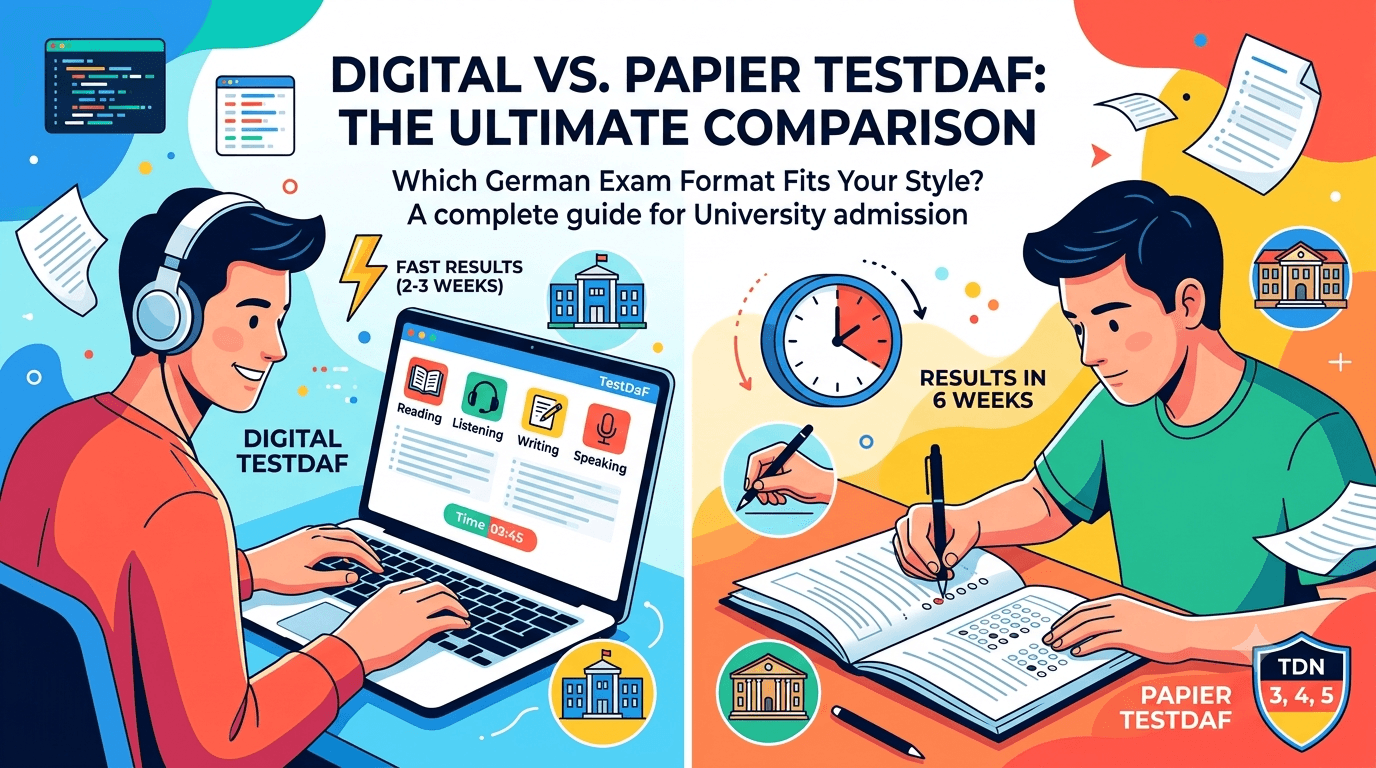
The Quick Snapshot: Digital vs. Paper TestDaF
Before we dive into the details, here is a quick side-by-side comparison of what to expect from both formats based on the layout parameters explained on the
TestDaF Structural Breakdown Subpage.
| Feature | Digital TestDaF | Paper-Based TestDaF (Papier) |
|---|
| Exam Delivery | Fully on a computer at a certified center | Paper booklet & pen (with audio via computer/headset) |
| Total Duration | Approx. 3 hours 15 minutes (No major breaks) | Over 4 hours (Includes administrative breaks) |
| Reading (Lesen) | 7 short tasks, 34 items (55 mins) | 3 long texts, 30 items (60 mins) |
| Listening (Hören) | 7 tasks, 30 items (40 mins) | 3 texts, 25 items (40 mins) |
| Writing (Schreiben) | 2 tasks (60 mins) — Typed | 1 long task (60 mins) — Handwritten |
| Speaking (Sprechen) | 7 tasks (35 mins) — Headset recording | 7 tasks (35 mins) — Headset recording |
| Result Availability | Fast! Approx. 2 to 3 weeks | Approx. 6 weeks |
| Navigation | Strict linear countdown; cannot go back | Free time allocation within the specific section |
Deep Dive: Section by Section Comparison
Don't let the identical target scores (TDN 3, 4, and 5) fool you. The way you interact with these tests is fundamentally different. Let's look under the hood.
1. Reading Comprehension (Lesen)
This is where you will feel the biggest format shift.
- The Paper Format: You get three long, dense academic texts. You have a full 60 minutes to manage however you like. If text 2 is a nightmare, you can skip it, do text 3, and come back later.
- The Digital Format: Instead of three giant texts, you get 7 smaller, modular tasks (34 items total). But here's the catch: the navigation is strictly linear. Each task has its own individual countdown timer. Once that timer runs out, or once you click "next," that task is gone forever. You cannot go back to check your answers.
The Verdict on Reading: If you get overwhelmed by massive walls of German text, the digital format is a lifesaver. The topics are shorter, meaning an unfavorable topic won't ruin a third of your reading score. However, you must be comfortable making a final decision on an answer quickly without looking back.
2. Listening Comprehension (Hören)
The Paper Format: 3 listening tracks (a campus dialogue, an interview, and an academic lecture). Two of these sections require you to write open-ended short answers by hand*.
- The Digital Format: 7 tasks with 30 items. You will see more interactive question types like multiple-choice, matching statements to speakers, and filling in visual diagrams. Only 3 out of the 7 tasks require you to type short answers.
The Verdict on Listening: The digital version offers a lot more variety and fewer open-ended text blocks, which many students prefer. Plus, digital centers offer great audio control and high-quality headsets. Just remember, the linear navigation rule applies here too!
3. Written Production (Schreiben)
This is usually the ultimate dealbreaker for most test-takers.
- The Paper Format: You get one single, massive essay prompt. You have 60 minutes to analyze a chart, summarize facts, and write a detailed argumentative essay by hand. If your handwriting is messy or your hand cramps easily, this can be brutal.
- The Digital Format: You get 2 tasks spread across 60 minutes. Task 1 asks you to summarize information from a text and a diagram (about 100-150 words). Task 2 is an argumentative text (minimum 200 words). You type both tasks on a keyboard.
The Verdict on Writing: Typing is faster, allows you to copy-paste, and lets you fix mistakes seamlessly without making your paper look like a crime scene. Typos aren't heavily penalized as long as the meaning is clear. For most digital natives, the digital format wins the writing round easily.
4. Spoken Production (Sprechen)
Surprise! Both formats actually require you to speak into a microphone connected to a computer. You won't be talking to a human examiner in either test; you'll be speaking to a "fictitious dialogue partner" through your headset.
- The Difference: The Digital TestDaF features "integrated tasks." This means you might have to read a short text or look at a presentation slide, and then orally summarize or critique it. It mimics real university life much closer (like participating in a seminar study group).
Crucial Tip: Beware of the QWERTZ Keyboard!
If you choose the digital exam, here is an essential piece of
TestDaF preparation tips: you will be using a physical German keyboard layout at the test center.
If you are used to the standard English layout (QWERTY), the
German QWERTZ keyboard can slow you down. The "Z" and "Y" keys are swapped, and the layout features dedicated keys for Umlauts (
ä, ö, ü) and the sharp S (
ß).
Make sure you change your keyboard layout settings on your computer at home and practice typing your essays using the QWERTZ layout before test day!
Is Digital TestDaF Easier?
It's the million-dollar question, right? The honest answer is:
neither is easier language-wise, but one might feel easier depending on your test-taking style.
- The Digital TestDaF is friendlier if you love variety, prefer typing over writing by hand, and get easily fatigued by long-form academic texts.
- The Paper TestDaF is friendlier if you hate being rushed by automated countdown timers, like to flip freely between pages, and want to highlight your text with a physical pen.
Pros and Cons Breakdown
Digital TestDaF
Pros:
- Insanely Fast Results: You get your scores in about 2 to 3 weeks (perfect if university deadlines are breathing down your neck!).
- More Testing Dates: g.a.s.t. offers more digital dates per year than paper ones.
- Easier Editing: Editing typed text is infinitely easier than crossing out handwritten paragraphs.
- Shorter Test Day: Total time is around 3 hours 15 minutes because the computer automates the transitions.
Cons:
- Linear Pacing: No going back to review previous questions.
- Screen Fatigue: Reading German for 3+ hours on a screen can be tiring.
- QWERTZ Layout: Requires getting used to the German keyboard.
Paper-Based TestDaF
Pros:
- Total Control over Time: You manage your minutes within each section freely.
- Familiar Setup: No software interfaces to learn; just good old-fashioned paper.
- Gradual Phasing: Less variety in task types means fewer specific strategies to memorize.
Cons:
- The 6-Week Wait: Waiting a month and a half for your certificate can ruin your university application timeline.
- Fewer Test Dates: Dates are becoming increasingly limited as the test moves fully digital.
- Handwriting Stress: Writing a complex essay by hand under strict time limits is physically exhausting.
The Verdict: Which One Should You Book?
If you are still on the fence, use this rule of thumb:
- Choose the Digital TestDaF if: You have a tight university application deadline, your typing speed is decent, and you like shorter, bite-sized tasks. (Honestly, for most students, this is the best recommendation!).
- Choose the Paper TestDaF if: You have plenty of time before your deadlines, you get anxious with on-screen countdown clocks, and you prefer having a paper booklet in your hands to highlight and take notes on directly.
Whichever path you choose, the absolute best way to prepare is to take a digital practice test or a paper mock exam. Check out the specific setup and log in using the
TestDaF Official Exam Preparation Subpage. Getting familiar with the exact software interface or booklet layout will take away half of your test-day anxiety.
For general details on registration fees or test locations, you can also review the
TestDaF FAQ Sheet. Good luck with your prep—you've got this! Viel Erfolg!