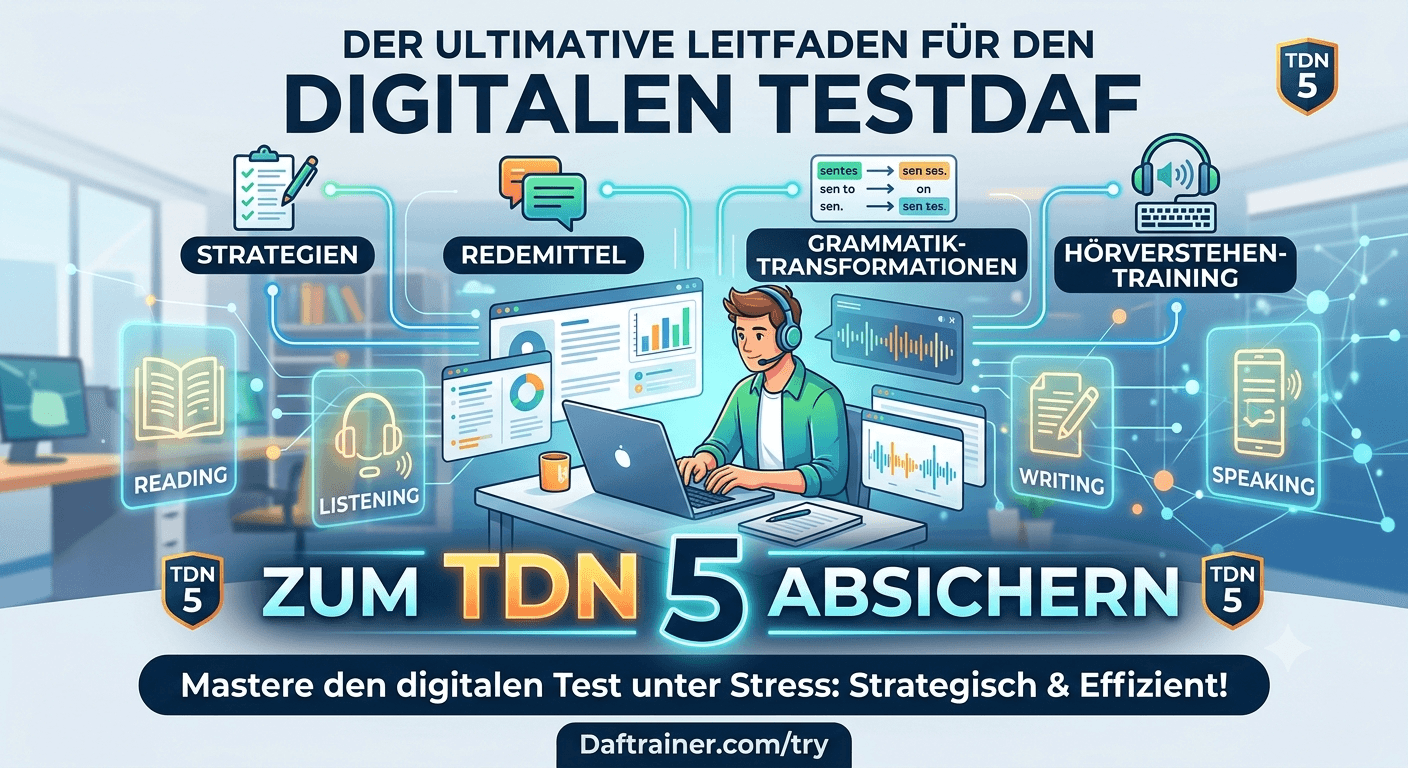
TestDaF vs. Goethe-Zertifikat C1: The Ultimate Deep-Dive Guide for University Hopefuls
By Alex Mercer Curriculum Lead & Senior Test Prep Strategist at Daftrainer Published: July 7, 2026Hey there, language warrior! If your roadmap involves studying, researching, or working in Germany, you are likely staring down the barrel of a major academic milestone: proving your advanced German language skills. When you scan the admissions requirements page of almost any German university, two prominent choices inevitably square off against each other: the TestDaF (specifically the modern Digital format) and the Goethe-Zertifikat C1. Both certificates are world-renowned, both can act as your golden passport past university gates, and both demonstrate that you can survive complex linguistic situations. However, treating them as interchangeable is one of the costliest mistakes an applicant can make. The structural architecture, thematic scopes, grading dynamics, and psychological pressures of these two exams are completely distinct. If you pick the wrong test for your specific learning profile, you risk spending months studying the wrong skills, failing a single hyper-specific module, and missing your university application window entirely. Let's lay everything out on the table. In this exhaustive guide, we are going deep under the hood to compare these two heavyweights section-by-section so you can choose the path of least resistance to your dream score.
The High-Level Profile: What Are These Exams Actually Built For?
Before analyzing the individual test items, we have to look at the foundational philosophy behind each exam's construction.The TestDaF: The Academic Simulation Engine
The TestDaF (Test Deutsch als Fremdsprache) is designed with a singular, laser-focused objective: assessing your absolute readiness to succeed inside a German public higher education institution. It does not care if you know how to talk down a landlord about an unfair utility bill, nor does it test your ability to debate fine art at a casual social gathering. Instead, it places you directly inside a virtual university environment. Every lecture you listen to, every text you parse, every essay you construct, and every verbal prompt you answer mirrors a real-world task you will encounter as a matriculated student. It spans a graded spectrum across the Common European Framework of Reference for Languages (CEFR) levels B2 to C1, translating your raw abilities into standardized TestDaF-Niveaustufen (TDN 3, 4, and 5).The Goethe-Zertifikat C1: The Advanced Generalist
The Goethe-Institut's C1 certificate is a holistic badge of advanced, native-adjacent fluency across general, professional, and cultural contexts. While widely accepted by higher education admissions boards, its DNA is rooted in general communication. Goethe requires you to handle highly nuanced abstract topics, decode sophisticated socio-cultural commentary, write formal administrative messages, and negotiate face-to-face with an actual human partner. It is a binary exam—you are either officially certified at the C1 level, or you are not. Here is a quick snapshot matrix comparing the core structural elements of both exams:| Feature | Digital TestDaF | Goethe-Zertifikat C1 |
|---|---|---|
| Target Audience | Aspiring university students & researchers | Students, working professionals, visa applicants |
| Core Theme | Strictly academic, campus life, applied sciences | Broadly cultural, societal, professional, abstract |
| CEFR Levels | Spectrum analysis (B2 up to high C1) | Flat-rate validation of true C1 competency |
| Delivery Medium | 100% Computer-based at a test center | Paper booklet or computer-based (varies by center) |
| Oral Format | Automated microphone recordings to an AI/interface | Live interaction with a human partner and examiners |
| Core Passing Limit | Typically TDN 4 in all 4 individual components | Minimum 60% (60 out of 100 points) per module |
| Flexibility | Highly linear navigation; strictly automated timers | Flexible time management within written blocks |
Theme & Vocabulary: Academic Rigor vs. Socio-Cultural Nuance
The linguistic barrier to entry on these exams manifests in completely different ways, demanding distinct preparatory strategies.The TestDaF Vocabulary Matrix
To conquer the TestDaF, your vocabulary must prioritize Wissenschaftssprache (academic language). You need to be fluent in parsing complex data transformations, interpreting scientific trend lines, and processing arguments regarding micro-plastics, structural changes in modern labor markets, or the pedagogical shifts of digital lectures. The sentence structures are dense with nominal styles (Nominalstil), passive voice constructions, and complex modal verbs. If you can elegantly use specific transition templates (Redemittel) to analyze a bar chart or explain cause-and-effect relationships in a laboratory environment, you will thrive here.The Goethe C1 Vocabulary Matrix
Goethe pivots away from sterile campus environments and plunges directly into advanced societal discourse. You will be reading commentaries regarding modern urban architecture, the psychological impacts of remote isolation, literary critiques, or historical retrospectives. The vocabulary demands a deep, intuitive understanding of German idioms, metaphorical expressions, stylistic subtext, and varied registers. You aren't just summarizing facts; you are identifying irony, tracking shifting emotional positions in an interview, and expressing opinions with precise rhetorical flare.Deep Dive: The Section-by-Section Battleground
Let's look at exactly what happens when you sit down in the examination room for each of the four core communicative modules.1. Reading Comprehension (Lesen)
TestDaF (Digital Format)
The digital reading section is a masterclass in linear pacing. You receive 7 modular, highly interactive tasks consisting of 34 total items spread over 55 minutes. You will be dragging and dropping assertions, matching short summaries to student research interests, and answering multiple-choice queries on complex scientific studies. The psychological kicker? Hard linear pacing. Each assignment has a strict, individual countdown clock as outlined on the TestDaF Structural Breakdown Subpage. Once that timer hits zero, the screen locks, submits your data, and moves forward. You cannot hoard time on an easy text to spend on a brutal paragraph later.Goethe C1
Goethe provides a traditional 70-minute block to tackle dense, lengthy essays, non-fiction review columns, and formal statements. You are tested on your ability to synthesize vast amounts of text and pull out highly hidden, implied meanings. The key advantage here is autonomous time management. If you want to blast through the first task in ten minutes and dedicate a massive 30-minute window to a confusing article about German historical preservation laws, you are completely free to do so. You can highlight text, flip back and forth, and continuously cross-reference your answers on the paper layout or screen interface detailed on the Goethe C1 Official Module Framework.2. Listening Comprehension (Hören)
TestDaF (Digital Format)
Consisting of 7 tasks and 30 items across roughly 40 minutes, the digital listening layout covers a wide range of academic audio. You will hear casual campus conversations between a student and a registrar, panel debates among university professors, and deep scientific lectures. The task variety keeps you on your toes: you will be clicking checkboxes, checking true/false statements, and typing out precise short answers for 3 of the sections. The audio generally plays exactly once, meaning your real-time processing and parallel note-taking strategies must be flawless.Goethe C1
The Goethe listening block lasts around 40 minutes and features longer, more abstract formats like localized radio documentaries, long-form cultural podcasts, and detailed telephone interviews. Crucially, major portions of the audio material are played twice. This completely alters your strategic approach. On the first pass, you can capture the macro-level structure and intent of the speakers; on the second pass, you can dial in on highly specific idioms, catch technical nuances, and refine your spelling and written notes.3. Written Production (Schreiben)
TestDaF (Digital Format)
You are allotted 60 minutes to complete two distinct assignments on a physical computer keyboard:- Task 1 (Information Synthesis): You are handed an academic text alongside a statistical diagram (like a line graph detailing renewable energy trends). You must accurately summarize the text and synthesize the visual chart insights in a clean, objective manner (typically 100–150 words).
- Task 2 (Argumentation): You are given a controversial thesis regarding university or global societal policies. You must write a highly structured argumentative essay weighing the pros and cons, detailing your personal stance, and backing it up with structured logic (minimum 200 words).
Goethe C1
Goethe hands you an 80-minute block where you must produce highly articulate, stylized texts split into two sections:- Task 1 (The Forum Post): You are provided with graphical data or point-driven prompts about a broad societal issue (e.g., public transit subsidies or meat consumption taxes). You must write a well-rounded, engaging forum contribution expressing an elaborated opinion of approximately 230 words.
- Task 2 (Formal Communication): You must craft a highly formal piece of correspondence—such as a professional email, an official complaint letter, or an academic request—strictly adhering to appropriate German formatting, stylistic greetings, and professional social codes.
4. Spoken Production (Sprechen)
This is the absolute deciding factor for many candidates. The delivery mechanism represents a night-and-day split in testing psychology.TestDaF (Digital Format)
You sit in front of a computer screen wearing a headset. You will interact with 7 automated tasks across 35 minutes. A simulated timer ticks down, a beep sounds, and you must instantly begin speaking into the microphone to address a fictitious dialogue partner (like a fellow student, a university advisor, or a lecture group). The prompts test academic tasks: summarizing a presentation slide, giving advice to a peer on class enrollment, or presenting a structured multi-perspective argument to a university committee. There is zero human feedback. No nodding head, no smiles, no clarifying questions. It is a pure, sterile race against the automated recording clock.Goethe C1
You are paired with a real human partner (another examinee) in front of a panel of physical examiners for a dynamic 10-to-15-minute live session:- Part 1 (The Solo Presentation): You receive a brief text stimulus, head to a quiet preparation room for 15 minutes to organize your thoughts on paper, and then deliver a structured, fluent monologue to the room. Afterward, you must answer follow-up questions from your partner and examiners.
- Part 2 (The Interactive Discussion): You and your partner are handed a scenario where you must collaboratively solve a problem, debate an issue, or come to a consensus (e.g., planning a cultural event or selecting a corporate training seminar).
The Grading Trap: Pass/Fail vs. The Dreaded "TDN 4 in All Parts"
How these exams calculate success can heavily influence your probability of passing on the first attempt.The Goethe C1 Modular Lifeline
The Goethe-Zertifikat C1 is fully modular. Each of the four parts (Lesen, Hören, Schreiben, Sprechen) carries a maximum weight of 100 points. To officially pass a module, you must clear a flat 60% threshold (60 points out of 100). Even better: if you completely bomb the writing module with a 45% score but ace the other three sections, you do not lose your entire progress! You only have to re-register for and retake that one isolated writing module at a later date. You can review the exact modular points distribution on the official Goethe C1 Official Module Framework.The TestDaF Profile Challenge
For decades, TestDaF was an all-or-nothing gauntlet. If your target university required a TDN 4 profile across all four modules to process your admission, and you scored a stellar TDN 5, 5, 5, but got a devastating TDN 3 in Speaking, your certificate was effectively useless for that specific enrollment window. You had to re-book, pay full price, and retake the entire multi-hour test from scratch. However, the modern digital infrastructure has radically evolved. As highlighted on the TestDaF Score Evaluation Portal, your raw points are mapped cleanly onto a unified 0–20 point scale per section. If you need to verify how universities weigh your final tier distributions, you can review the official TestDaF-Niveaustufen (TDN) Definitions. Furthermore, test-takers can now utilize the Combined Certificate feature via the g.a.s.t. portal. You can digitally stitch together your highest section scores achieved across multiple different digital exam attempts to form an optimal profile, bypass the old penalizations, and safely show your true C1 capabilities.Counterargument: Is the Goethe C1 Secretly Better for University?
While the TestDaF is tailored for higher education, a strong argument can be made for pursuing the Goethe C1 instead under specific conditions.- The Human Element Advantage: Many students suffer from severe microphone anxiety. Speaking into an automated system with a ticking digital timer can cause intermediate speakers to freeze up, leading to unearned TDN 3 scores. If your conversational skills are fluid, natural, and socially adaptive, you can leverage your personality to score much higher in a live Goethe panel interview.
- Grammar and Idiomatic Strengths: TestDaF completely lacks a dedicated grammar testing module. It evaluates your grammar indirectly through text production. Goethe C1, on the other hand, heavily rewards deep structural mastery, advanced idiomatic prose, and structural precision. If your learning style is deeply analytical and rooted in textbook mastery, Goethe provides an arena where those skills shine.
Action Checklist: Which Test Should You Register For?
Still stuck at the crossroads? Run your current situation through this strategic checklist to make a definitive decision.You should absolutely choose the Digital TestDaF if:
- [ ] Your primary goal is entering a German public university degree program (Bachelor, Master, or PhD).
- [ ] You are highly comfortable with computer-based testing environments, typing under pressure, and using a German QWERTZ keyboard layout.
- [ ] You prefer shorter, structured, highly technical tasks over long, fluid cultural essays.
- [ ] You want your results back rapidly (2–3 weeks for digital vs. up to 6 weeks for traditional paper formats).
- [ ] You struggle with social anxiety and prefer speaking into an automated headset rather than debating an unknown human partner face-to-face.
You should absolutely choose the Goethe-Zertifikat C1 if:
- [ ] You need a multi-purpose certificate for visa processing, general employment, or corporate internships outside of strict academic fields.
- [ ] You are applying to specific artistic, musical, or humanistic university faculties that explicitly state a preference for general C1 certifications over academic profiles.
- [ ] You cannot handle automated countdown clocks on individual test questions and require absolute freedom to manage your time within reading blocks.
- [ ] You want a safety net where failing one module doesn't invalidate your passing scores in the other three components.
- [ ] Your handwriting is fast, legible, and clear, and you excel at organic human conversations.