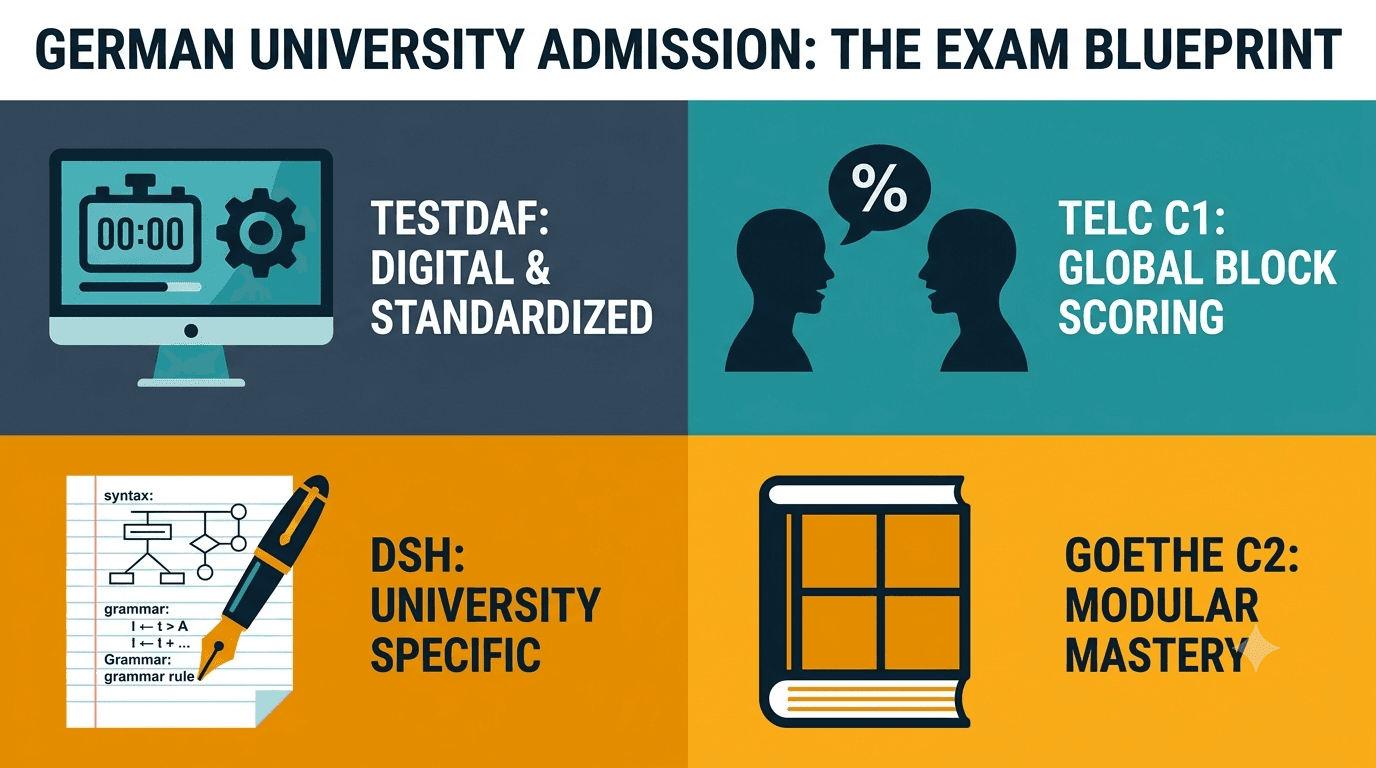
TestDaF vs telc vs DSH vs Goethe: The Strategic Blueprint for German University Admission
You have spent months drilling grammar rules, learning vocabulary, and dreaming of studying at a German university, but now you are completely paralyzed trying to decide whether to register for the TestDaF, telc C1 Hochschule, DSH, or a Goethe certificate.
Picking the wrong exam will cost you hundreds of euros in registration fees, extend your preparation by months, and potentially cause you to miss your university application deadlines entirely. To verify your local university deadlines, you can check the central
uni-assist application platform. This guide will dismantle the hidden structural traps of each test so you can select the exact path that matches your skills and guarantees your university admission.
Here is the exact blueprint comparing task structures, scoring rules, logistical timelines, and preparation strategies for all four major German language exams in 2026.
The Four Contenders: Formats and Structural Philosophy
Choosing an exam requires you to understand that these tests are not created equal, as each one targets a completely different type of learner. The
digital TestDaF is a highly standardized, computer-based exam administered globally at official test centers by
g.a.s.t.. You can manage bookings and view deadlines through the
g.a.s.t. centralized user account portal or read the core criteria on the
digital TestDaF dashboard. It evaluates your academic readiness using automated systems and very strict, predictable task structures. If you like highly standardized formats and prefer typing over writing by hand, this is your baseline.
The
telc C1 Hochschule represents a more traditional, paper-or-digital blended approach that focuses heavily on authentic academic communication. It is widely accepted across German universities and administered via the
telc standard portal. It is famous for its unique structural flexibility in grading and is often favored by students who excel in real-world conversations and structured essay writing.
The
DSH (Deutsche Sprachprüfung für den Hochschulzugang) is a unique beast because it is not standardized nationally. Individual German universities write, administer, and grade their own unique versions of the DSH. You can explore how individual universities manage this by reviewing the
Humboldt-Universität Berlin language subdomain or checking the layout from the
Uni Münster language centre. You can usually only take it if you already hold a conditional admission letter from that specific institution.
The
Goethe-Zertifikat C2 (Großes Deutsches Sprachdiplom) is the ultimate linguistic mountain offered by the
Goethe-Institut global portal. While the Goethe C1 is occasionally accepted, universities universally accept the C2 certificate for any degree program. It is a modular exam, meaning you can test individual sections over time rather than passing everything in a single day.
| Exam | Primary Format | Average Cost | Retake Policy | Best For |
|---|
| TestDaF | Digital at test centers | €170 - €210 | Must retake all sections | Standardized preps outside Germany |
| telc C1 Hochschule | Paper or Digital | €150 - €230 | Can retake oral or written separately | Students with uneven skill levels |
| DSH | Paper-based at university | €100 - €180 | Depends on the university | Students already located in Germany |
| Goethe C2 | Paper or Digital | €250 - €320 | Fully modular per section | Long-term planners, native fluency |
Takeaway: Next time you open your calendar, look up your target university's international admissions page to confirm they accept all four choices, though 95% of German institutions treat TestDaF (TDN 4) and telc C1 Hochschule as completely interchangeable.
The Scoring Traps: Profile vs. Global Block Grading
The way an exam calculates your final score is the single most important factor for your success strategy. The TestDaF uses a strict
profile scoring system where you receive a separate TestDaF-Niveaustufe (TDN) score from 3 to 5 for each of the four modules. Most universities require a
TDN 4 in all four sections for full admission. If you score a brilliant TDN 5 in Reading, Listening, and Writing, but slip to a TDN 3 in Speaking, you fail the university entrance requirement and must retake the entire exam.
In stark contrast, telc C1 Hochschule uses a
global block scoring system that offers a massive safety net. The exam is split into two independent blocks: the written exam (Reading, Language Elements, Listening, and Writing) and the oral exam. To pass, you only need to score
60% total in the written block and 60% in the oral exam. This means a spectacular score in Reading can completely compensate for a terrible performance in your essay.
The DSH operates on a similar total-percentage model, divided into tiers. You need a
DSH 2 to enroll in standard courses, which requires an overall score of 67% across the combined exam sections. Like telc, strong sections can balance out weak ones, making it significantly more forgiving than the uncompromising TestDaF profile requirements.
Goethe C2 offers a completely different advantage through its
modular independence. You must clear 60 points out of 100 in each module to pass, but the modules are entirely separate certificates. If you fail the Writing module, you only pay for and re-sit the Writing module at a later test date, preserving your passing scores in the other three sections.
Here is how a real-world student scenario plays out under different scoring systems:
- The Student Profile: Excellent reader and listener, competent speaker, but struggles significantly with rapid essay production under intense stress.
- TestDaF Result: Leseverstehen (TDN 5), Hörverstehen (TDN 5), Mündlicher Ausdruck (TDN 4), Schriftlicher Ausdruck (TDN 3) -> Result: Denied University Admission.
- telc C1 Hochschule Result: Reading (90%), Listening (85%), Speaking (75%), Writing (45%) -> Combined Written Block averages out well above 60% -> Result: Approved for University Admission.
Takeaway: Before choosing your test, take a full diagnostic mock exam to identify if you have an uneven skill profile; if one section is consistently weak, favor telc C1 Hochschule or DSH over TestDaF to leverage their compensation rules.
The Testing Environment: Human Examiners vs. The Countdown Clock
The physical testing environment fundamentally impacts your operational speed and anxiety levels. In the digital TestDaF, you sit at a computer terminal inside a room filled with other test-takers. For the
Mündlicher Ausdruck (Speaking) section, you do not talk to an interviewer; instead, you wear a headset and speak directly into a microphone while a
digital countdown clock ticks down on your monitor. You are recording your voice simultaneously alongside twenty other students in the same room, creating a loud, chaotic environment that requires absolute mental focus.
Conversely, telc C1 Hochschule and DSH preserve the
human element of testing. The speaking component is an interactive oral exam conducted face-to-face with real examiners and usually a partner test-taker.
The structural demands of the writing sections also vary wildly between these exams. The digital TestDaF forces you to complete two complex writing tasks within 60 minutes, focusing heavily on structured argument presentation and data synthesis. The telc C1 Hochschule gives you a generous 70 minutes for a single, deeply analytical academic essay (Erörterung) where you must take a clear position on two contrasting statements.
Your linguistic register must adapt to the specific exam expectations, as shown in this stylistic comparison:
- Weak Academic Phrasing (Risky for all exams): "Ich finde Umweltschutz wichtig, weil Autos viel Schmutz machen."
- Strong TestDaF/telc Academic Register: "Es ist von zentraler Bedeutung, effektive Umweltschutzmaßnahmen durchzuführen, da der Individualverkehr maßgeblich zur kontinuierlichen Luftverschmutzung beiträgt."
Notice how the strong version replaces basic verbs like
finden and
machen with precise academic expressions like
von zentraler Bedeutung sein and
durchführen. The structural complexity directly satisfies the grading rubrics for high-level certification.
Takeaway: Spend 15 minutes practicing speaking aloud while a loud television or radio plays in the background; if you cannot maintain your train of thought, avoid the digital TestDaF room environment and opt for a face-to-face oral exam like telc.
Grammatical Hurdles: Isolated Testing vs. Natural Production
If you choose telc C1 Hochschule, you must face a specific section called
Sprachbausteine. This is a dedicated grammar and vocabulary gap-fill test that does not exist in the TestDaF format. TestDaF does not test your grammar in isolation; it only evaluates your grammatical accuracy implicitly through your writing and speaking production. If you hate memorizing pure prepositions, adjective endings, and fixed idioms out of context, TestDaF shields you from that specific pain.
The DSH takes grammar testing to an even higher level by including a section explicitly named
Wissenschaftssprachliche Strukturen. In this module, you must rewrite complex academic sentences into alternative grammatical structures without changing the meaning. You are forced to transform nominal styles into verbal styles, or active sentences into passive constructions with modal equivalents.
Look at this exact before-and-after transformation required by typical DSH exams:
- Original Sentence (Nominal Style): "Nach der Einführung der neuen Technologie stiegen die Produktionszahlen erheblich."
- Required Grammatical Transformation (Verbal Style): "Nachdem die neue Technologie eingeführt worden war, stiegen die Produktionszahlen erheblich."
If you have not mastered these precise structural transformations, the grammar portion of the DSH will destroy your overall score. TestDaF candidates never have to perform these mechanical transformations, as they only need to deploy their grammar naturally within their own written essays.
Takeaway: Review your mastery of advanced German syntax; if mechanical grammar transformations terrify you, cross DSH off your list immediately and focus your energy on TestDaF.
Receptive Modules: Screen Navigation vs. Live Note-Taking
The receptive modules of these exams test entirely different processing methods. The digital TestDaF forces you to navigate text on a screen, utilizing digital highlighting tools to flag keywords. The tasks require you to match statements, complete multiple-choice items, and determine whether text arguments match specific academic perspectives. The time limits are strictly isolated, meaning you cannot finish the reading section early and use those extra minutes to review your listening responses.
In the DSH listening section, you face a completely unique academic simulation. An examiner reads a long, complex lecture aloud twice in the examination hall. You must take comprehensive handwritten notes on blank paper during the reading, and only after the second reading do you receive the actual question sheet. You must then synthesize your raw notes to write open, full-sentence answers to highly specific academic questions.
Let us compare the structural processing demands of these formats:
- TestDaF Reading/Listening: High speed, digital interface, recognition of synonyms, strict automated countdowns per task.
- telc C1 Hochschule Reading/Listening: Global matching tasks, multiple-choice items, structural language elements, paper or screen formats depending on the test center.
- DSH Reading/Listening: Extreme focus on manual note-taking, open text production, synthesis of a live spoken lecture, high volume of manual writing.
If your handwriting is slow or your note-taking skills are unorganized, the DSH listening format becomes an absolute minefield. TestDaF and telc insulate you from note-dependency by presenting clear question prompts that remain visible throughout the entire assessment process.
Takeaway: Try a 10-minute note-taking exercise using an authentic German academic podcast; if your notes lack the structural depth to answer detailed questions afterward, avoid the DSH and focus on the guided formats of TestDaF or telc.
The Logistical Reality: Location, Deadlines, and Availability
You cannot pass an exam that you cannot physically sit for. The TestDaF possesses the most robust
global infrastructure. It is administered multiple times per year at hundreds of certified test centers across more than 90 countries worldwide. This allows you to secure your university language certificate long before you ever book a flight to Germany.
The telc C1 Hochschule has rapidly expanded its network, but it remains heavily concentrated inside Germany. While international testing centers exist, they are far less common, meaning most students take telc while enrolled in language pathways within German cities. However, telc results frequently process faster than TestDaF, often releasing official certificates within two to three weeks compared to the standard four-to-six-week wait time of TestDaF.
The DSH presents the tightest logistical restrictions. Because it is organized locally by individual universities, you must travel to Germany to take it. To analyze regional structural differences, you can cross-reference guidelines on the
Heidelberg University study center. Furthermore, you generally cannot just sign up online; you must apply for a degree program, receive a conditional acceptance letter (
Zulassungsbescheid), and then accept the university's invitation to sit for their specific DSH seat.
Review this checklist to determine your primary logistical constraints:
- [ ] Do you need a confirmed language certificate to apply for your student visa from your home country? (If yes, prioritize TestDaF or Goethe C2).
- [ ] Are you already living in Germany or attending a local language school? (If yes, telc C1 Hochschule or DSH become highly accessible).
- [ ] Is your university application deadline less than six weeks away? (If yes, look for quick-processing telc digital test dates or local DSH options).
- [ ] Do you have a history of failing single sections by a narrow margin? (If yes, look for a modular Goethe C2 slot or the compensation rules of telc).
Takeaway: Mark your target university application deadlines on a timeline, then map backward by exactly eight weeks to select your test date, ensuring a realistic cushion for grading delays and shipping times.
Strategic Selection: Which Exam Fits Your Specific Profile?
Your choice boils down to a clear alignment of your personal learning strengths against the structural design of the tests. If you are highly disciplined, comfortable using computers under time pressure, and prefer highly predictable task structures that you can systematically train for using templates,
TestDaF is your optimal target. The digital format eliminates messy handwriting penalties and lets you navigate your writing tasks efficiently.
If your language skills are uneven—such as being a fantastic reader but struggling to produce perfect grammar during timed essay writing—
telc C1 Hochschule is the strategic winner. Its block scoring system protects your investment and ensures one difficult writing task does not destroy months of hard work. It is also the ideal choice if talking directly to a real human examiner helps soothe your test anxiety.
For students who are already situated in Germany, holding a conditional university admission notice, the
DSH offers a highly practical shortcut. It is often cheaper, tightly aligned with what that specific university values, and frequently paired with affordable, high-intensity prep courses run by the actual test examiners.
To make your final decision clear, review this diagnostic matrix based on common student archetypes:
IF you need a certificate abroad AND want predictable tasks
-> Choose TestDaF
IF you have uneven skill levels AND prefer human oral examiners
-> Choose telc C1 Hochschule
IF you are already in Germany with a university admission letter
-> Choose DSH
IF you want to pass modules one by one over several months
-> Choose Goethe C2
Takeaway: Choose your test format today and stick to it completely; switching between preparation systems mid-way through your studies dilutes your focus and wastes valuable time.
The single most critical factor in your university journey is matching your specific language profile to the scoring rules of your chosen exam. Do not leave your university admission to chance by entering an exam room unprepared for its structural design.
Your immediate next step is to lock in your strategy by trying a full, realistic practice simulation. Head over to our comprehensive
Daftrainer resources to baseline your skills, master your timing, and start building the exact academic structures examiners look for.